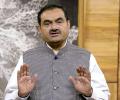
Embattled Adani Group on Monday said it has put on hold major equipment procurement and site construction activities for the Rs 34,900 crore petrochemical project at Mundra in Gujarat as the project has not yet tied up finances. The group's flagship Adani Enterprises Ltd (AEL) incorporated a wholly-owned subsidiary, Mundra Petrochem Ltd in 2021 for setting up a greenfield coal-to-PVC plant at Adani Ports and Special Economic Zone (APSEZ) land in the Kutch district of Gujarat. Asked by stock exchanges to comment on a PTI report on Sunday that the group has suspended work on the project, AEL said, "The financial closure of the Green PVC project of Mundra Petrochemicals Limited ( MPL) is pending with the financial institutions and it is in their active consideration."

Damage from new shenanigans can be contained if regulators move quickly when something does not smell right, counsels Debashis Basu.
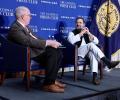
Asserting that Indian democracy is a "global public good", Congress leader Rahul Gandhi has said that its "collapse" will have an impact on the world and is not in America's national interest.

'With our focus and strategy we can solve at least 20 per cent per cent of India's education problems.'

After six years in the business, the scorecard of Bengaluru-based QwikCilver is impressive, with a 90 per cent market share.

There are multiple near-term worries for the stock of India's largest listed consumer company, Hindustan Unilever (HUL). While inflationary pressures will weigh on its profitability, demand pressures - especially in the rural market - are expected to hit the firm's revenues. This is why brokerages have cut the earnings estimates for financial year 2022-23 (FY23) by 7-10 per cent.

Laxman Narasimhan, a veteran in leading and advising global consumer-facing brands, has been named as the new CEO of coffee giant Starbucks, joining a growing cohort of Indian-origin business leaders at the helm of global corporations.

The average time lag between the date of occurrence of a fraud and its detection is 23 months; for large frauds (Rs 100 crore and above), it was 57 months.

'Generic skills are in abundance, but technological advancements have left staple skills redundant.' 'It is why employers are now looking for alternate sources of hiring -- deploying gig workers, looking at Tier 2 and Tier 3 cities for relevant talent.'

India's equity markets are on a roller-coaster ride, after delivering spectacular returns for two consecutive years - in 2020 and 2021. The benchmark National Stock Exchange's (NSE's) Nifty50 is down 1.5 per cent in the first nine months of the current calendar year 2022 (CY22) as foreign portfolio investors sold Indian stocks due to rising bond yields in the US and across global markets, including India. The sell-off in the Indian equity markets has, however, not been broad-based and largely limited to sectors facing earnings headwinds from rising interest rates, lower commodity and energy prices, and likely economic recession in advanced economies.

Microsoft has become the first global Big Tech company to join the Open Network for Digital Commerce (ONDC), an Indian government initiative for developing a first-of-its-kind open network for digital commerce. The world's second-largest technology firm intends to introduce social e-commerce via its app in the Indian market later this year. ONDC is expected to open to the public in Bengaluru over the next fortnight as it enters into the next phase of the pilot for further fine-tuning before rollouts in other cities, according to a source in the know.
HDFC Bank Q4 review: HDFC Bank's January-March quarter (Q4) results, for financial year 2022-23 (FY23), brought no cheer to investors as elevated costs, and merger-related uncertainties continue to dent the sentiment. Moreover, analysts fear that merger-related costs may put pressure on margins and cost to income ratio in the near-term, while the return on equity could moderate owing to low leverage of the parent. Analysts, therefore, opine that the stock's re-rating may be some time away. "While the risk of a de-rating on a standalone basis appears to be quite low given that the business performance is holding up well, we believe a re-rating in the stock would happen as and when more clarity emerges on the smooth transition (merger)," said a report by Sharekhan.

"China creeps towards hegemony in Asia, threatens India's borders, and treats other countries as junior partners, Indian-American Congressman Ro Khanna said.

Ajit Balakrishnan on keeping an eye on democratising finance in India.
Digital payments and financial services firm Paytm is likely to allocate shares at the upper price band of Rs 2,150 apiece on November 16 after market regulator SEBI's approval which is expected to come on Monday, sources aware of the development said. Earlier the allocation was expected to take place on Monday and the Paytm Money app also displayed the same.

After a fresh round of human rights dialogue, India and the European Union on Friday concurred on the importance of safeguarding freedom, independence and diversity of civil society actors, including human rights defenders and journalists.

In conversation with Deepsekhar Choudhury and Neha Alawadhi, Sharma speaks about his journey and the road ahead.

'At the heart of the strategic relationship between our countries are economic ties.'

Justice Kohli said the advent of artificial intelligence has caused some concerns amongst the legal fraternity.

The 'sudden volatility' in Adani stocks is entirely due to a series of events that was extreme and unique, and played out in too short a period. Investors and regulators pretended that it wasn't so. But then, along came Hindenburg, which forced some eyes to open, points out Debashis Basu.

The IMD attributed the projection to a weakening of El Nio and the Indian Ocean Dipole turning positive.
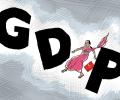
India's economy continues to be robust, but downside risks such as rising crude oil prices, adverse weather conditions, and the global banking crisis outweigh the upside potential in gross domestic product (GDP) growth in the current financial year (FY24), the finance ministry said on Tuesday in its Monthly Economic Review for March. "We reiterate that downside risks to our official forecast of 6.5 per cent for real GDP growth in FY24 dominate upside risks," the review said. "Opec's surprise production cut has seen oil prices rise in April, off their lows of low-seventies per barrel in March.

The world of golf was left stunned as the PGA Tour, DP World Tour and LIV circuit, who have been involved in a bitter fight, announced a shock agreement!

It's hard to say because of the winner-take-all nature of new platform and network businesses, but Reliance has not been an efficient user of capital, and Adani numbers are varied, observes T N Ninan.

'To set up a successful business, one must have a solution to an existing problem or a better way of addressing the current solution.'

US tech giant IBM is betting big on the India growth story and plans to open more software development centres in the country as it looks to partner with the government in its digitisation journey, its chairman and CEO Arvind Krishna said on Friday. On a visit to India, Krishna met Finance Minister Nirmala Sitharaman, Telecom Minister Ashwini Vaishnaw and Minister of State for IT Rajeev Chandrasekhar to discuss deeper collaboration including skilling and workforce development. The firm that originally designed the technology and system behind ATMs, barcodes and the US social security net, is greatly enthused with the speed at which the Indian government is willing to make decisions and where it is moving, he told a select media briefing.
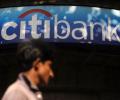
Axis Bank's acquisition of Citibank's consumer finance business for Rs 12,325 crore - the second biggest deal in the Indian banking sector - is seen as a good deal at a good price. The acquisition enables Axis Bank to close the gap with competition in some key segments such as credit cards. At the same time, there are some key issues that are crucial for the deal's success, apart from the fact that it will take some time for Axis to reap the full harvest of its investment.

...followed by financial services, IT, and sales and marketing.

Seth had served as the Professor of Management at Virginia Tech, US and also held the position of Professor of Business Administration at the University of Illinois.
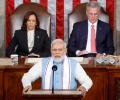
Here's the full text of Prime Minister Narendra Modi's address to a joint session of the United States Congress, delivered on Thursday.
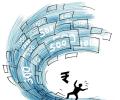
Mutual funds focused on investing in fixed-income securities witnessed a heavy outflow of Rs 92,248 crore in June on uncertain macro environment, driven by expectations around an increasing rate cycle, higher commodity prices and slowdown in growth. This comes following a net outflow of Rs 32,722 crore in May and an inflow of Rs 54,756 crore in April, data available with Association of Mutual Funds in India (Amfi) showed. Out of the 16 fixed-income or debt fund categories, 14 witnessed net outflows during the month under review.

'With nearly double the market share of our nearest competitor, we are shaping the digital transformation journey of close to 1,000 clients in India.'

Business schools will teach you a lot but there are certain things that you cannot learn in a classroom.

The dinner Jill Biden and her husband US President Joe Biden hosted for Indian prime minister Narendra Modi, June 22, at the White House brought together, Indians and Americans from so many firmaments.

Today, Apollo Tyres is the first made-in India automotive brand to be sold in Europe independently.

This makes it the most valued fintech company in the country after Paytm and Walmart-owned PhonePe.
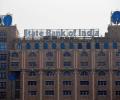
SBI chief Rajnish Kumar said the focus going forward will be on cost reduction, rationalisation and reskilling of workforce, improving staff productivity and redeployment of workforce from admin offices to sales roles.
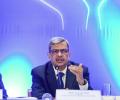
'Had there been no war, maybe, we would come out with a 7.5 per cent stake sale.' 'At this point in time, a 3.5 per cent stake sale looked good.'

Billionaire philanthropist George Soros believes the turmoil at Gautam Adani's business empire may weaken Prime Minister Narendra Modi's hold on the government -- a statement which was strongly countered by BJP as an attack on Indian democracy.

Brokerages are expanding the universe of stocks they cover amid a boom in the market. Several stocks in the mid-cap universe are now tracked by more analysts than they were a year ago. For instance, SBI Cards and Payment Services is now tracked by 17 brokerages, compared to just four a year ago.
